Arkus Innovation Studios
Ship Log 003 · Login is not a page
This week we worked on the Arkus Suite login system. The useful lesson was not about the login screen. It was about redirects, domains, sessions, production checks, and the small operating habits that decide whether a system feels real.
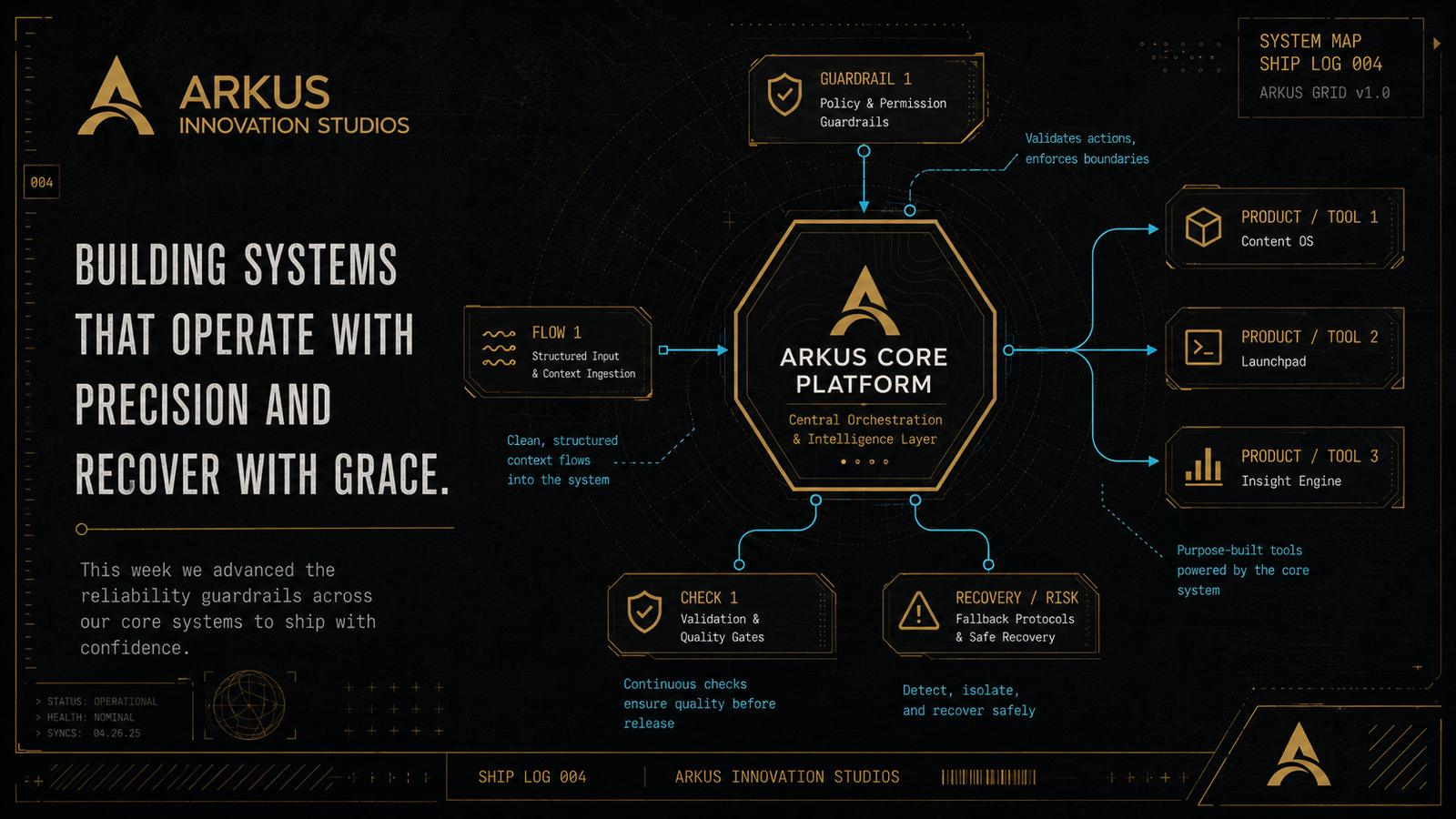
This week we worked on the Arkus Suite login system.
That sentence sounds smaller than the work actually was.
A login screen is the visible part. The real system is everything behind it: which domain owns the member session, which product receives the handoff, how long a handoff token lives, whether a redirect is allowed, whether a browser lands in the right place, and what happens when production has a slightly different idea than preview.
Preview is polite. Production is not.
The domain challenge
The first challenge was simple.
A product domain was supposed to redirect users through the central Arkus member portal. But the configured destination and the current domain matched. The middleware saw a product URL, tried to send it to its canonical version, and sent it back to itself.
Again.
And again.
That is how a clean-looking domain decision becomes control flow.
The fix was also simple: if the current domain and canonical domain are the same, do not redirect. Continue into normal authentication handling instead.
The lesson is the part worth keeping. Domain configuration is not copy. It is application behavior. When the system uses domains to decide access, product identity, and session handoff, every host value becomes part of the auth path.
The proof challenge
After the redirect fix, the public checks passed.
Product pages redirected once to the Arkus login page. No loop. No broken landing. No obvious issue.
That was useful.
It was not complete.
The real proof is the authenticated path: a member signs in at the portal, the portal creates a short-lived handoff, the product verifies it, the browser receives a product session, the one-time code cannot be reused, and the user lands inside the product without logging in again.
That is the actual round trip.
A public redirect check can prove the door is no longer jammed. It cannot prove the key works.
So we wrote the production smoke path down as a real runbook. Not a vague "test login." The actual sequence: portal mint, product callback, token verification, cookie creation, code stripping, replay rejection, entitlement check, and final landing.
This is where "done" gets expensive if you use it early.
The operations challenge
There was a second challenge this week, and it was more avoidable.
We added a group of users into the main access system. The provisioning worked. The users had the right access level.
But an interim production deploy came from a local checkout that had unrelated changes in it. Those changes briefly affected the interface.
The database operation was correct. The deployment boundary needed to be cleaner.
This kind of issue does not need a new framework. It needs a rule:
Operational data work should not ride along with unrelated app changes.
If a temporary helper is needed, isolate it. Remove it. Deploy from a clean target. Better, do the operation without touching the app surface at all.
This is not glamorous engineering. It is the part that keeps the product from looking worse while the data gets better.
The larger pattern
The rest of the week had the same shape.
Index got stricter about report evidence. The system now does more work to distinguish what was retrieved, what was verified, what was inferred, and what could not be found. That matters because a diligence report is only as useful as its ability to explain where the evidence came from.
VentureIP moved from a launch surface toward an operating workspace. The portal got cleaner. The handoff into external tools got clearer. A fund communication area was added so the product can hold an ongoing conversation, not just a static report.
Cipher accepted the Arkus Suite handoff path. That still needs live validation in the product environment, which is exactly the kind of note that should stay visible until the test is done.
MarketRadar became less tied to one demo and more useful as a reusable client intelligence workspace, with Portuguese-first presentation and a clear split between demo-safe behavior and live model behavior.
Different repos. Same theme.
We were not adding more AI for the sake of adding more AI.
We were adding boundaries.
Which domain owns the session.
Which product can accept a handoff.
Which report claims were actually retrieved.
Which mode is demo-safe and which mode calls a live model.
Which operational changes are allowed anywhere near production deploys.
A demo can survive ambiguity.
A production system cannot.
Back next week.
Sheldon