Arkus Innovation Studios
Ship Log 005 · The operator surface is the product
This week we worked on the operator surface: the access queues, evidence views, demos, boundaries, and recovery paths that make the system trustworthy.
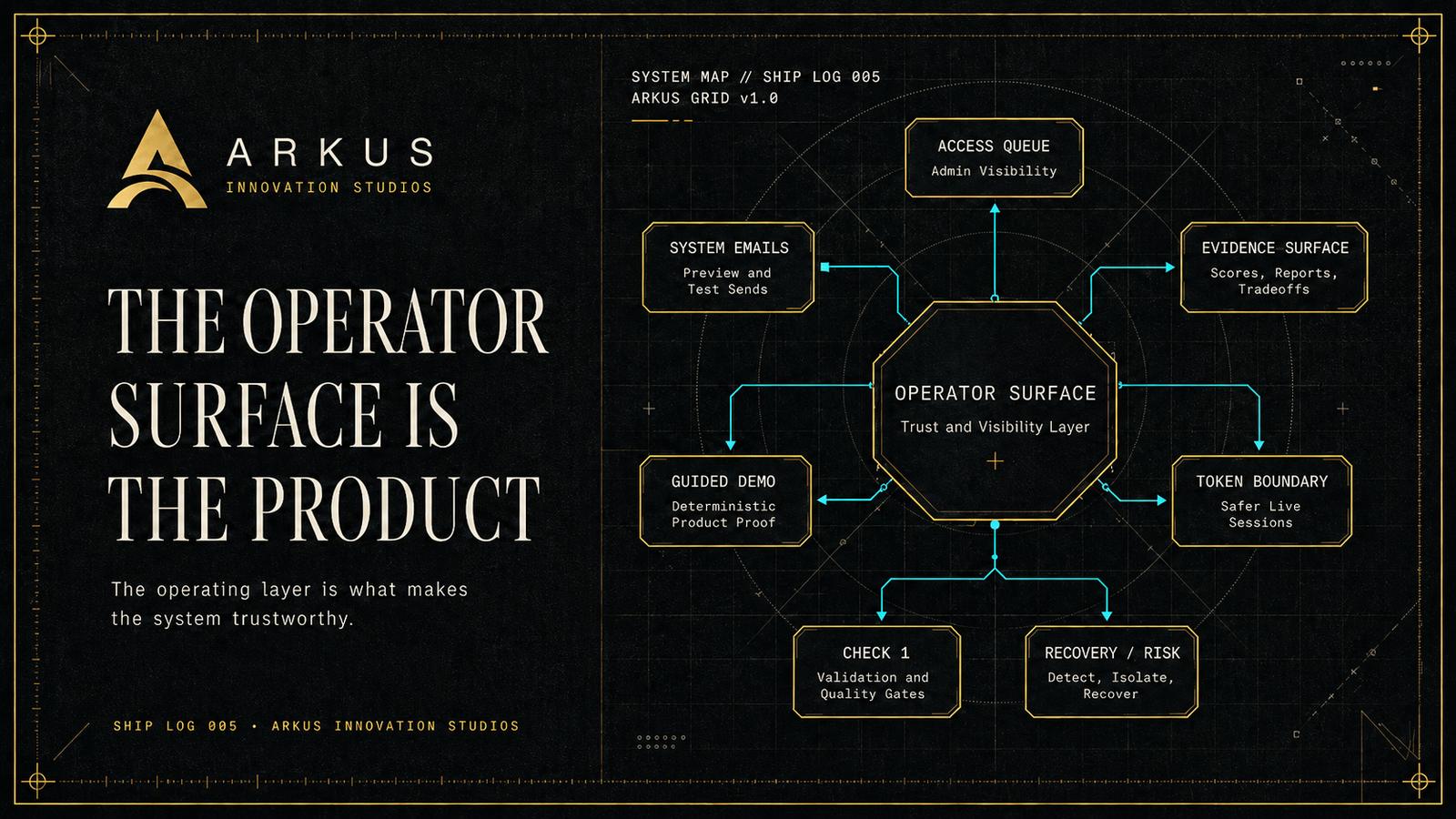
This week we worked on the operator surface.
That is not a separate product.
It is the part of the product that tells you what happened, what failed, what needs attention, and what can be trusted without someone reconstructing the system by hand.
A user sees a checkout button, a report, a guided demo, or a voice session.
An operator needs to know whether an access request landed, whether an email failed, whether a report claim came from evidence or inference, whether a demo is using live AI or a deterministic engine, and whether a voice session closed because the model failed or the token was too constrained.
The screen is the part people remember.
The operating layer is the part that decides whether they trust it.
The access challenge
Arkus Insider kept moving from membership surface to control surface.
The request-access path got a premium pass. Checkout and billing buttons now show pending states instead of letting someone double-submit into Stripe. The public marketing site got a cleaner visual language, brand assets, and sharper copy.
Transactional emails became visible to admins. Welcome, trial-expiring, payment-failed, and subscription-canceled emails now have previews and test-send paths. They are deliberately not editable in the admin UI, because these are access and billing emails. If one changes, it should change through code review.
That is the right boundary.
Then the access-request queue exposed a useful failure.
An access request could look invisible to the admin queue. That is not the kind of behavior you want in a membership product.
The follow-up found two things. The admin did not have enough queue visibility, and notification failures could be present without being easy enough to find. So the admin layout now feeds a pending-count badge into the navigation, and the email-failed view catches admin-notification failures too.
A queue that hides work is not a queue.
The evidence challenge
Cipher had a different version of the same problem.
The redesign this week was visual, but it was not a costume change. The product became easier to operate as an intelligence workspace without loosening the scoring contract underneath it.
The shell got brighter tokens, a collapsible sidebar, and a return path back to Arkus Insider. Results gained a verdict gauge, a calibrated radar chart, and a score credential. Prioritization moved into a scatter view with execution and opportunity axes. The analysis state became a real progress instrument instead of a decorative loading surface.
The useful constraint: the scoring logic stayed anchored.
The gate thresholds still come from the product constants. The bands still move at 38, 62, and 81. Sanitized markdown stayed on the existing safe rendering path. Gold stayed reserved for the score credential.
Index had the report version of the same pattern.
The cover and section dividers moved into a forensic dossier design: cream paper, registration marks, specimen fields, and section-specific wireframe diagrams. It looks more like something a board or partner could take seriously.
But getting that look required changing the PDF render path. The global footer came out so the cover and dividers could render full-bleed. That also removed page numbers from content pages.
That is a real tradeoff.
A report can look premium and become harder to use. The right answer is to name the tradeoff, decide whether content pages need in-document page numbers, and keep the cover clean.
The demo challenge
MarketRadar became Arkus Mirante this week.
The important part is that it now behaves like a partner-runnable commercial-intelligence demo instead of a fragile walkthrough. It has a welcome path, a guided demo, and a free sandbox. It runs on a deterministic engine by default, so no API key is required. It is bilingual in English and Portuguese.
The guided demo tells one story: capture, rank, interpret, decide, share, ask, handoff.
The point is less explanation, more proof.
The polish pass made the numbers more honest. Value at risk is computed from live opportunity data. The baseline reads R$ 325K / 2 accounts exposed, then rises to R$ 511K / 3 when the tour captures a contested signal. Competitors edited in Personalize now flow into the engine. Market reads return structured signals and recommended moves instead of a paragraph pretending to be analysis.
Then the demo found a practical bug.
A coachmark could cover the exact thing it was supposed to explain.
The placement logic guessed the card height at 380 pixels. One panel had 374 pixels available. The card fell back to the center and hid the live action.
So the fix was to measure the card for real and never center it over the target.
If the demo hides the proof, the demo is the problem.
The boundary challenge
The public website and Notion work was quieter, but it may matter just as much commercially.
The website now speaks more consistently about pricing, process, and offers. Startup Diagnostic, Portfolio Diagnostic, AI Workflow Sprint, Arkus Insider, and Innovation Compass are aligned more cleanly across the public site and the Notion sales workspace.
Legacy routes still work. The old venture diagnostic route maps to Startup Diagnostic. The portfolio diagnostic route is the canonical Portfolio Diagnostic path. AI sprint aliases map to AI Workflow Sprint. Funnel submissions carry durable session and submission IDs. Calendly handoff can carry explicit lead and submission hints back into the CRM.
A public funnel that says one thing while the CRM records another thing creates operational fog. The fog eventually reaches the client.
Arkus AI had the sharper version of the boundary story.
A browser-exposed credential path moved server-side. The app now mints short-lived, single-use Gemini Live tokens through an authenticated token endpoint. Then production voice sessions started closing with 1011 Internal error after about a second.
The token flow worked. The token constraint was wrong.
The token was locking too much of the Live connect config, so the client could not send the system instruction, session resumption, or speech configuration it needed. The fix was precise: set lockAdditionalFields: [], so the field mask locks only the model.
Now the token pins the model and leaves the session setup room to work.
That is what a trust boundary is supposed to do.
Constrain the dangerous part. Do not accidentally break the useful part.
The larger pattern
Different products. Same week.
Arkus Insider needed admins to see access work before it disappeared into the system.
Cipher needed the intelligence surface to become easier to operate without loosening the scoring contract.
Index needed premium report packaging without pretending page numbers were a minor detail.
Mirante needed a guided demo that showed the product instead of covering it.
The website needed sales taxonomy, funnel routes, and Notion records to agree.
Arkus AI needed live voice credentials to be safer and more precise.
That is the operator surface.
It is not always the part you sell.
It is often the part that decides whether what you sold survives first contact with real users.
Back next week.
Sheldon